
Amateur Radio
Amateur radio has been fascinating me since I was a kid, and I passed my amateur radio exam in
1971 while still working as a radio operator in the military.
Amateur radio is not just a sophisticated hobby. It is a non-commercial radio service for the
purpose of intercommunication, education, and technical research. Although it has got a touch
of nostalgia in the era of cellular phones and global satellite communication, amateur radio
is anything but outdated. In fact, it has been an experimental medium from the very beginning,
and many inventions in the field of wireless communication have been (and are being) made by
radio amateurs. Moreover, amateurs can provide an alternative communication network in case of
natural disasters and other emergency situations because they do not depend on a complicated
infrastructure. There are many examples of rescue operations in which radio amateurs have been
involved. Actually, one of the thrills of amateur radio is self-sufficiency. A battery-powered
shortwave transceiver and a simple wire antenna is basically all you need to communicate with
other amateurs, even over thousands of miles.
Running an amateur radio station requires a license issued by your national telecommunication
authorities. To obtain one, you have to prove adequate knowledge of radio technology,
communication rules, regulations, etc. Further, proficiency in Morse code may be required,
depending on the respective license class. The license you get after passing the exam includes
a call sign. The latter is your ID when you are "on the air".
As a licensed amateur, you are privileged to build your own radio equipment or modify existing
products according to your needs. You are free to experiment as long as you observe the
regulations concerning transmitting power, frequencies, spurious emissions, safety, etc.
Otherwise, amateurs couldn't be so creative. Alternatively, many commercial products designed
for amateur radio are available on the market.
Training courses for people interested in joining the world-wide community of radio amateurs are
provided by the national amateur radio societies. You can find the address of your national
radio club on the web site of the International Amateur Radio
Union, IARU.
|
Click here to learn more about amateur radio.
A few useful links:
AC6V's Amateur Radio and DX Reference Guide
eHAM.net
Here is a short description of my own radio station (as of 2000):
| Callsign: | DK5HY | |
| Location: | N 53° 20' 34'' E 9° 52' 00'' (WGS84) | |
| QTH Locator: | JO43wi | |
| Shortwave Bands: | 80m, 40m, 30m, 20m, 17m, 15m, 12m, 10m | |
| Modes: | CW and SSB (mostly CW) | |
| Antennas: | 3-Band Groundplane (WARC bands), Long Wire (all bands) | |
| Organization: | DARC |
The following pictures show my equipment (always under construction):
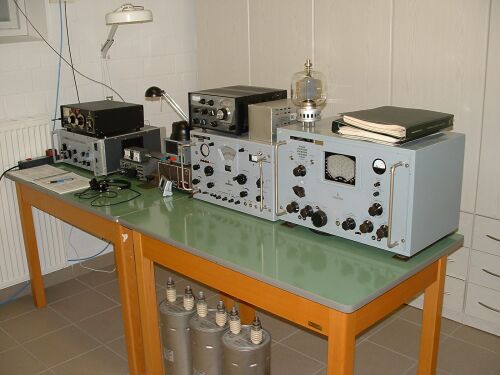 |
My Radio Station
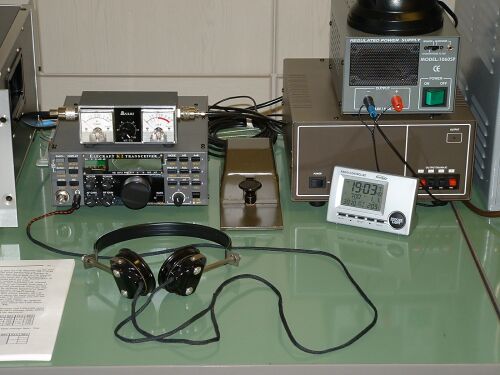 |
Elecraft K2 Transceiver, SWR Meter, Morse Key, Power Supplies
The K2 is a highly sophisticated, compact transceiver designed for amateur radio. It is supplied as a building-kit.
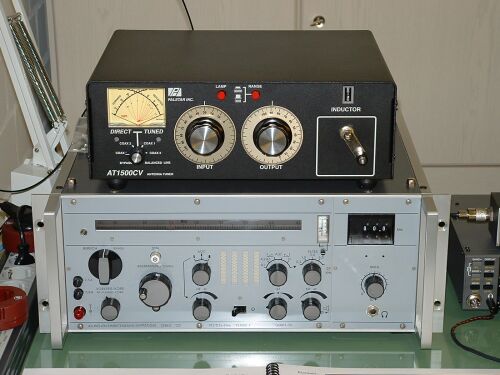 |
DEBEG 7201 Communications Receiver, Palstar AT1500CV Antenna Tuner
The DEBEG 7201 (= Siemens E 410) is an all-transistor general-coverage receiver from the mid-seventies.
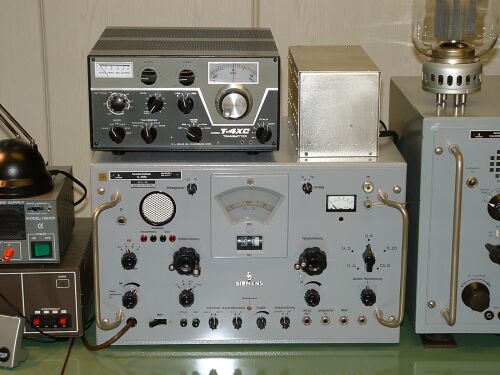 |
Siemens E 311 Communications Receiver, Drake T-4XC Transmitter, Drake AC-4 Power Supply
The E 311 is from the mid-sixties and still in excellent condition. It is a masterpiece of tube technology and mechanics. If it were manufactured today, it would be unaffordable. My relationship with this receiver is somewhat sentimental because I spent many night shifts in front of an E 311 during my military service back in 1970/71.
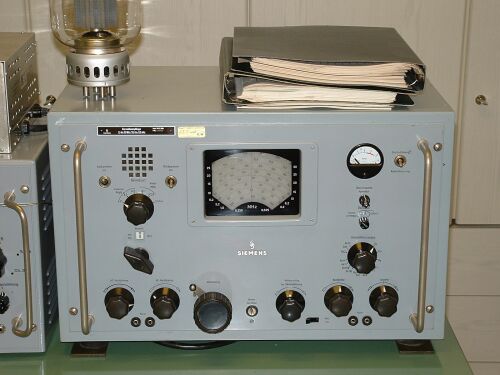 |
Siemens E 309 Communications Receiver
The E 309 (around 1960) is a heavy piece of equipment (weight: 38 kg / 84 lbs). It is a typical receiver from the pre-SSB era. AM and CW reception is remarkably good.
Update:
The above photos illustrate the status of my equipment as it was 20 years ago. After a break of many years, I resumed my radio activities on the occasion of my retirement in 2020. The next photo shows my station after a thorough modernization.
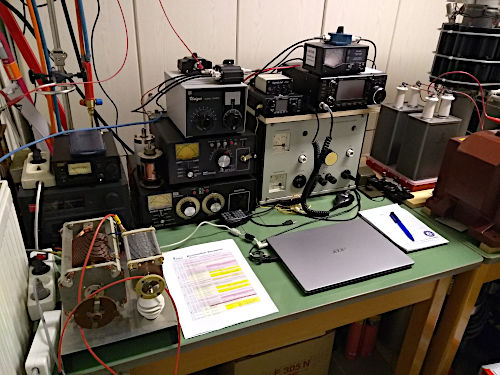 |
Station as of 2020
The tube equipment has found a new home in the attic. Instead, two digital transceivers (ICOM IC-7300 and XIEGU G90)
form the core of the station now, supplemented by various power supplies, antenna tuners, interfaces, etc.
My present antenna is a classical Windom with a single-wire feeder line for 40, 20, and 10 meters. I use the same
antenna as an asymmetrical T-antenna for the other bands (including 160 m). The original Windom antenna is notorious
for causing BCI and TVI but since I operate at low power most of the time, this has not been a problem up to now.
My favorite bands are 80, 60, 40, 30, and 20 m with occasional excursions into the 160 m band. My favorite modes of
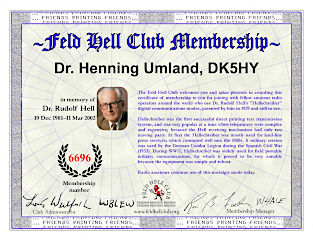
operation are BPSK31, FELDHELL, RTTY, and Olivia (others may follow).
 |
 |
 |
Click here to see a simple soft-starter circuit.
Click here to learn something about my ELF receiver project.